New Research Consortium Report Explains Why PAYERS Must Take the Lead in Changing the Way We Approach and Treat Cancer

Sep 16, 2026
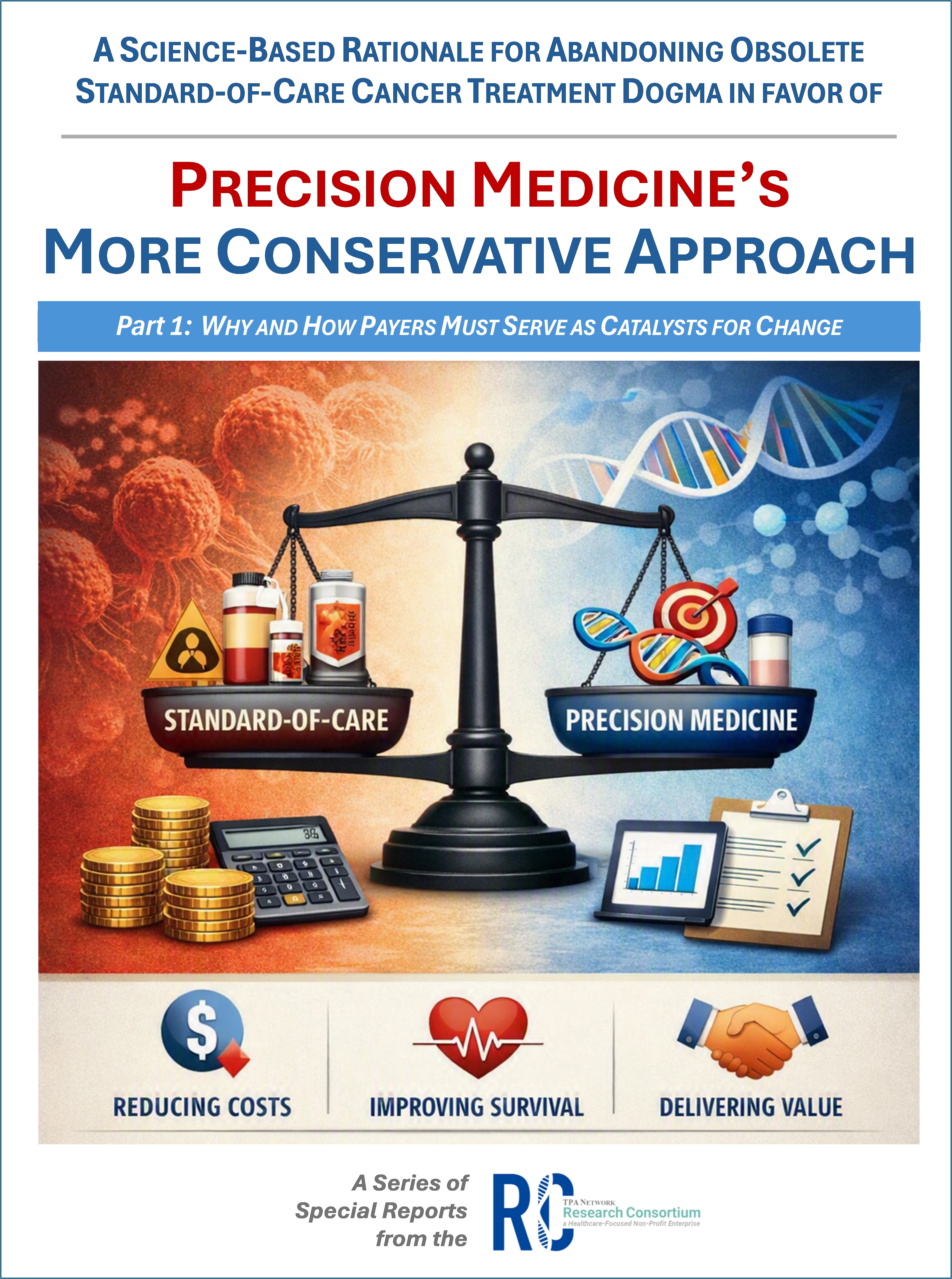

The transition from outdated, one-size-fits-all standard-of-care cancer treatment to science-based personalized care cannot be left to physicians / health systems: it must be led by payers / employer plan sponsors who make critical coverage decisions


San Diego, California Sep 15, 2026 (Issuewire.com) - A new report from the nonprofit TPA Network Research Consortium explains why health insurers must bear much of the responsibility for changing how cancer is approached and treated.  The first-in-a-series report details how payers can help drive this change by following the organization's Precision Medicine Protocol, a framework for supporting a more individualized approach to cancer care.

It is possible that as many as 80% of cancer patients in the United States receive suboptimal care, in large part because of the continued reliance on organ-based, one-size-fits-all clinical guidelines that do not adequately account for the variation among individual cancers.  When treatment decisions are guided by these generalized approaches rather than by the unique characteristics of each patient's cancer, patients may receive toxic, high-cost regimens that offer limited or no clinical value. Instead, treatment should be more appropriately aligned with the biology of the disease it is intended to treat.

Precision medicine integrates modern genomics into cancer care, substantially deepening our understanding of the disease and transforming how it can be treated.  Rather than relying on sameness-based, standard-of-care approaches, it uses each patient's unique molecular profile to guide the selection of therapies that are biologically matched to their cancer.   This approach helps identify targeted and potentially effective drugs while eliminating treatments that are unlikely to provide clinical value.  By avoiding ineffective therapies, precision medicine can reduce unnecessary toxicity and improve outcomes while containing cost.  It is a conservative, more cautious and science-based approach to care -- one that stands in clear contrast to blindly following obsolete, pre-genomic-era treatment dogma.

Research Consortium founder Richard Nicholas, a 48-year healthcare industry veteran, believes that payers continue to perpetuate suboptimal cancer care because they have not made a meaningful commitment to precision medicine. In his view, that commitment is essential to ensuring that cancer treatment decisions better reflect the unique characteristics of each patient's cancer.

"Organ-based cancer treatment must be superseded, as it excuses decision-making based on incomplete knowledge.  By contrast, precision medicine's science-based, look-before-you-leap treatment approach is actually a more conservative course of action versus blindly following obsolete pre-genomic era dogma.

"It is high time for payers and health plan sponsors to earnestly embrace precision medicine.  To do otherwise would be to continue to deny patients access to vital genomic testing and the option to try potentially viable FDA-approved cancer drugs; essentially permitting continued wasteful spending on high-cost, low-clinical-value drugs"   Richard L. Nicholas

Payers' Responsibility to Advance Precision Medicine

Comprehensive health care coverage is a cornerstone of effective cancer care; and coverage decisions shape access, quality, cost, and outcomes throughout the cancer journey, influencing everything from the initiation of treatment through long-term survivorship. When coverage decisions deny, delay, or disrupt access to care, they affect not only the treatment patients receive but also the outcomes they experience. Nicholas believes that because payers make coverage decisions, much of the responsibility for driving the transition to precision medicine rests with them.  He reasons that responsibility cannot rest entirely with providers and health systems, which do not control coverage determinations.  Payers must therefore earnestly embrace precision medicine and support coverage decisions that advance more effective cancer care, rather than continuing to accept ineffective treatments and wasteful spending on them.

A Practical Framework for Advancing Precision Medicine

To help health insurers and self-funded employers drive meaningful change, the nonprofit Research Consortium created a Precision Medicine Protocol as a practical framework for supporting more effective, individualized cancer care.  This report, the first in a series on precision medicine, describes the protocol and explains how and why payers can support its use. It also examines how payers can promote cancer care that is better aligned with individual patient needs while addressing the quality, cost, and value considerations that shape coverage decisions. Later installments in the series will provide additional detail about the protocol, challenge conventional thinking about the cost and value of combination drug treatments and show payers how to gain greater control over oncology specialty-drug spending.

The report is available for download here.

Should you wish to learn more about how you can support our work, please click on this link to our new fundraising campaign, Advancing Personalized Cancer Care.  Cancer patients everywhere will be glad you did.

About the TPA Network Research Consortium

The TPA Network Research Consortium is a non-profit, industry-wide healthcare research initiative that helps providers evaluate and assess new medical technologies and innovations, plan participants  obtain leading-edge healthcare, scientists  advance medical research, and payers reduce risk ... by conducting payer-focused translational research, in real-world settings.  Visit ResearchConsortium.org
Media Contact

TPA Network Research Consortium, Ltd.


[email protected]

8583954114

555 Saturn Blvd, Suite B408

http://www.ResearchConsortium.org

Source :TPA NETWORK RESEARCH CONSORTIUM LIMITED

This article was originally published by IssueWire. Read the original article here.

More News

GISBH: KPWKM prioritises swift reunification of rescued children with families

GISBH: KPWKM prioritises swift reunification of rescued children with families

Oct 15, 2024

KUALA LUMPUR: The immediate return of children rescued during Op Global to their parents and families is a top priority for the Ministry of Women, Family and Community Development (KPWKM). However, its minister, Datuk Seri Nancy Shukri said KPWKM must first ensure that the children’s parents and families can provide adequate and proper care. “For cases where the capability of the parents and families is clearly established, the reunification process can proceed without delay. In more complex situations, intervention programmes will be implemented to ensure the children’s and families’ best interests are safeguarded “The ultimate goal is to reunite these children with their families. However, before this can happen, several factors need to be carefully evaluated. This is not about denying anyone’s rights, but about ensuring the best interests of the children are upheld,” Nancy said during a minister’s briefing session on GISB Holdings Sdn Bhd (GISBH) in the Dewan Rakyat today. As of yesterday, 560 children – 283 boys and 277 girls – had been placed in safe custody after the Social Welfare Department (JKM) obtained a temporary court custody order for two months under Section 25(2)(a) of the Child Act 2001. Meanwhile, Nancy said the Task Force Profiling Team for Op Global found that 94.3 per cent of the 558 profiled children had at least one living biological parent, while 5.7 per cent had no parents or no available information on their parents. Health assessments showed that 51.6 per cent of the children were underweight, falling below the healthy Body Mass Index (BMI), while 46.1 per cent had a normal weight and the remaining children were classified as obese, she added. “Three children have been issued persons with disabilities (PwD) cards, while 27 others display symptoms of disability,” she added. Cognitive assessments were also conducted on 385 children aged seven and above, with 71.9 per cent (277 children) showing no signs of cognitive disorders, she said. “However, 20.26 per cent (78 children) displayed moderate cognitive disorders, while 7.79 per cent (30 children) were found to have severe cognitive impairments,” Nancy said.

Investigations ongoing into incident of empty Johor checkpoint counters with green lights on, blocked pathways

Investigations ongoing into incident of empty Johor checkpoint counters with green lights on, blocked pathways

Oct 15, 2024

PETALING JAYA: A surprise inspection by Johor Public Works, Transport, Infrastructure, and Communications committee chairman, Mohamad Fazli Mohamad Salleh recently found 17 Immigration counters at the Johor checkpoint empty. The inspection was conducted following a video circulating online showing the 17 empty counters at the checkpoint in Sultan Abu Bakar Complex (KSAB), triggering public backlash. He confirmed that the surprise inspection found that the incident actually occurred, Harian Metro reported. The video showed the empty counters, with green lights on however, the pathways were closed off to commuters. ALSO READ: Woman calls out Immigration officer for alleged rude behaviour Fazli then instructed that the green lights to be turned off to indicate that the lane is closed, to ensure no one is confused. “If there is no solid reason given regarding the incident, this can be considered intentional,” he was quoted as saying. On the other hand, Johor Immigration director Datuk Mohd Rusdi Mohd Darus said an internal probe will be conducted on the incident. ALSO READ: Woman expresses gratitude to Johor Immigration officers for returning lost RM1.5k “The internal investigation will determine whether the immigration officer handling the counter neglected their duties or intentionally left the counter without permission. “We will not tolerate this behaviour, and strict disciplinary action will be taken against them if they are found to have neglected their duties. “It is a violation of responsibility, and I take this issue seriously,“ he was quoted as saying.

Malaysia should seize opportunity in global medical devices market - Chang

Malaysia should seize opportunity in global medical devices market - Chang

Oct 15, 2024

KUALA LUMPUR: Malaysian innovators and manufacturers should seize the opportunity to tap into the immense potential of the global medical devices industry, which is projected to reach nearly US$800 billion by 2030, says Science, Technology and Innovation (MOSTI) Minister Chang Lih Kang. Chang noted that Malaysia had many high-quality products and innovators in the medical devices sector, with the government continuously encouraging and supporting industry players in research and development (R&D) and commercialisation efforts. “The market is vast, and we have plenty of room for success. To support R&D, of course, not limited to the medical devices industry, MOSTI offers various funding facilities, grants, matching grants, and equity where we invest in relevant startups,” he said. Chang said this to reporters after officiating the soft launch of INNOMed: Innovation Pitching Powered by PERANTIM, a key event in the International Medical Device Exhibition & Conference (IMDEC) 2024. Also present were Medical Device Authority (MDA) chief executive officer Dr P. Muralitharan, Malaysia Medical Devices Manufacturers Association (PERANTIM) president Johari Abu Kasim, and organising chairman of INNOMed, Dr Hyzan Mohd Yusof. Earlier in his speech, Chang said that under Malaysia’s New Industrial Master Plan (NIMP) 2030, the government aimed to foster synergies between the manufacturing and engineering sectors and the medical devices sector. This includes creating advanced inspection tools, solutions for imaging and endoscopy, implantable devices, and minimally invasive surgical tools. Meanwhile, Muralitharan told Bernama that, according to figures from the Department of Statistics Malaysia (DOSM), Malaysia’s total trade in medical devices, valued at RM25.61 billion from January to July this year, increased by 23.5 per cent compared to the same period in 2023 (RM20.74 billion). He added that the export of medical devices was valued at RM20.15 billion, an increase of 25.7 per cent compared to RM16.02 billion in 2023. In his speech, Dr Hyzan said that medical device innovation presented an opportunity to improve healthcare while boosting the economy, with the industry projected to reach nearly US$2 billion by 2025, making it one of the fastest-growing sectors. “By focusing on innovation, we can create high-skilled jobs, reduce our dependence on imported technologies, and position Malaysia as a global leader. Last year, we spent US$5 billion on medical devices, with 95 per cent being imports. Our goal is to reduce this to 50 per cent within five years,” he said. He also emphasised that close collaboration among universities, innovators, manufacturers, clinicians, and government agencies was key to ensuring that ideas and research transitioned smoothly from laboratories to clinical applications and into the hands of healthcare providers. INNOMed, themed “Unleashing the Power of Medical Technology: Shaping the Future of Healthcare,“ is organised by the MDA and will take place from Dec 10 to 12 at the Kuala Lumpur Convention Centre (KLCC).

YOUR NEWS, OUR NETWORK.

Do you have Great News you want to tell the world?

Be it updates about your business or your community, you can make sure that it’s heard by submitting your story to our network reaching hundreds of news sites across 6 verticals.

Utara Selatan

Bringing you from Utara to Selatan, we publish travel guides to make sure you will discover new places to visit in Malaysia and try all the local delicacies.

Newsletter